
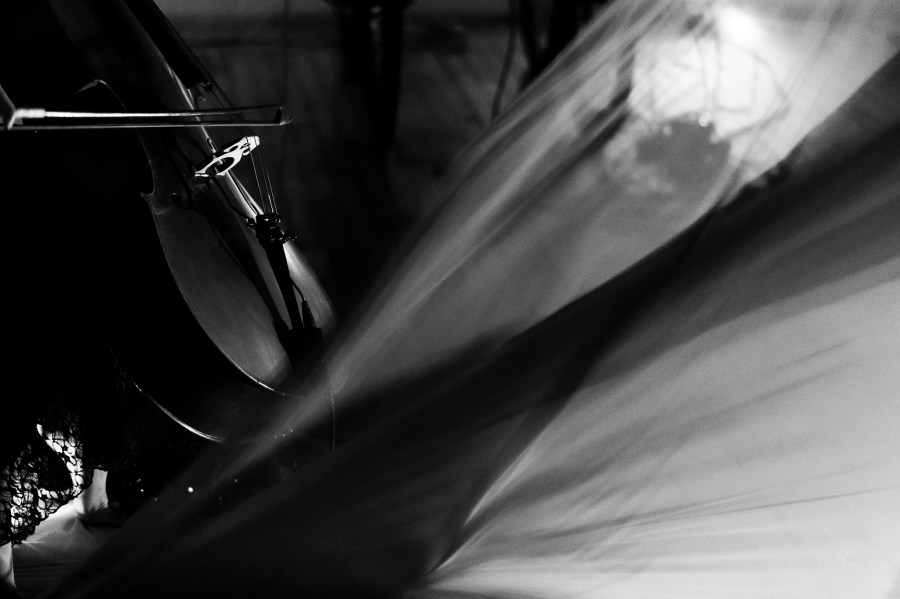
A stricking part of a cello is it’s spike, feels very much like a weapon for us who see it, to the player feels more like a steady footing, to a classical player that is, to Sofía it’s rather like a boat’s anchor, holding her flight, but I guess its both the function and the pricey burden of loving big bodied instruments. You see, Sofía was meant to be a repertoire interpreter, but things went other way, as she furthered into her trainning she felt more and more constrained, like if in learning to fly the instructions led to the painful lesson that you can only soar in certain ways and for strict, non-negotiable purposes. No bird flies like that. No musician should place pleasure at the bottom of priorities, and pleasure for Sofía often means going beyond herself, beyond her known world, discovering the limits of her feelings, thoughts and emotions, both private and musical, and by going far thus trying to blurr the distance between art and self. So she is willing and ready to jump at the unknown, which is exactly what Yuko needs as a partner.
Yuko’s mother raised her in her native tongue, italian, was brought up through her first childhood in Bolivia which made spanish her natural thinking language, through her teenage years she lived a bit in France, Italy, a bit here and there until she finally stablished in México. So where does she feel at home? Everywhere and nowhere, except when she’s with her cats, those curious animals that agree to live with humans without being domesticated. Yuko, as a vocal performer, understands that the human voice —that neverending mystery for which the ancient greeks gave a specific word—is the expression of a whole body, not just the vocal tract and the resounding bones but every fiber, mucose and gland, and then the body moves, and the singing voice, wether it howls or growls, clasps or opens in clear tones, moves too into uncharted territory.
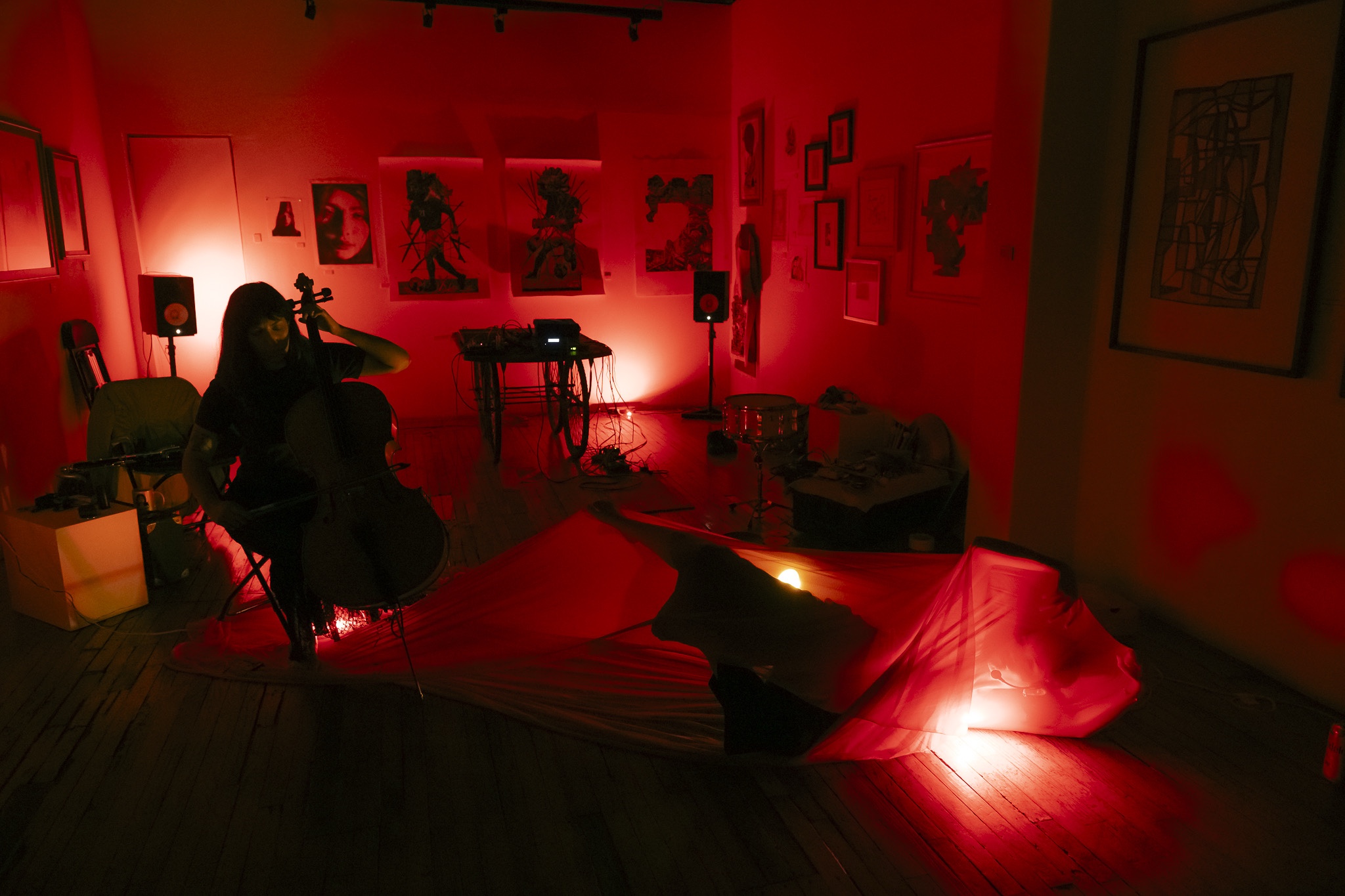
For Yuko and Sofía, making music involves their whole being and together they have created a string of tension, a material one, by means of a large fabric cloth, pinned down on one side by the cello’s tail spike and on the other wraping Yuko’s body, every sound gives birth to a movement, every pull at the fabric can summon even Sofía’s human voice, rasping as if her vocal chords were being stroked very close to the bridge, every loosening of fabric instability responds to a cackling or a long wailing from Yuko. They’ve told me that for them their performance has a feeling of giving birth, the fabric playing a placenta and umbilical chord of sorts, what for the rest of us takes place is the birthing of a chance and play of our own inner tensions, which need not be resolved but nurtured.
I do believe they do succeed in going beyond themselves, I think so not only because the work they create together relapses in a kind of trance that is unpredictable and unavoidable, but also because I recorded the performance and some month later sent it to them, and both Yuko and Sofía reacted exactly the same, by asking What’s this? Who’s playing?
Erick Vázquez

